
Are Auto Repair Memberships Plans Really Saving You Money? What Consumers Should Know Before Paying Annual Maintenance Fees
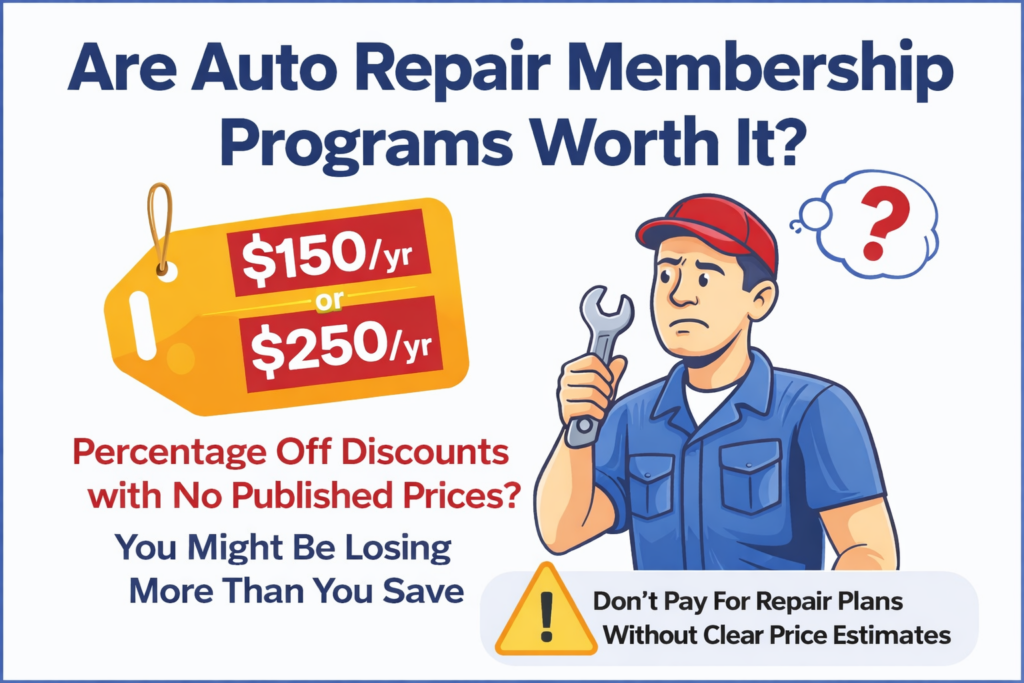
Drivers searching for an oil change near me, auto repair discounts, or car maintenance memberships are increasingly seeing annual plans that promise “50% off oil changes,” “discounted repairs,” and other perks for a yearly fee. For example, some posted plans advertise a $150/year “Simple” plan and a $250/year “Preferred” plan, with extra charges for diesel and European vehicles, plus percentage-based discounts on services like oil changes, batteries, filters, fluid replacements, and repairs. Some also note that benefits are only available at certain affiliated businesses, such as “Specific Centers” or “Only certain locations”
The problem for consumers is not that discount plans always have zero value. The real issue is pricing transparency. If a membership heavily promotes percentage discounts but does not clearly publish the normal retail price of the underlying services, shoppers have a hard time knowing whether they are actually getting a deal. Without a visible starting price, the business keeps control of the comparison, and the customer cannot easily verify whether the “discount” reflects a genuine savings opportunity or simply a number calculated from a price the customer never saw in advance. That makes these plans difficult to evaluate in the real world.
Why percentage-off repair memberships can be risky for consumers
A plan that says “50% off oil changes” sounds powerful, but a percentage discount by itself does not tell the full story. If the base service price is not posted clearly, the customer cannot compare that offer against an independent shop with straightforward everyday pricing. Consumer Reports notes that prepaid maintenance plans should be compared against the actual price of the services covered, and Edmunds similarly says these plans may only make sense if the customer can confirm the package beats normal retail pricing.
That matters because the math can be misleading. If Shop A charges a transparent everyday price of $70 for a service, and Shop B advertises that same service at $120 but gives membership holders 50% off, the “discounted” price would still be $60. On paper, the customer feels like they saved 50%, but in reality they only saved $10 compared with the transparent shop — and that is before paying the annual membership fee. That example is hypothetical, but it shows why discount percentages without publicly visible base prices can create the illusion of major savings while making it harder for the consumer to judge value. This is exactly why upfront pricing matters.
The annual fee can wipe out the “savings”
Some plans show an online cost of $150 per year for Simple and $250 per year for Preferred, with an additional $100 charge for diesel and European vehicles. That means a diesel or European vehicle owner could pay $250 or $350 per year before receiving any service at all. A consumer needs to save more than that fee just to break even. If the driver only gets one or two routine services a year, the membership may not pencil out — especially if comparable shops already offer fair everyday pricing without a subscription.
This is why consumer advocates and auto-shopping guides repeatedly recommend doing the math first. Consumer Reports says buyers should compare the plan cost to the cost of the actual maintenance it covers, and Edmunds says a prepaid plan may only be worth it if it beats normal retail prices. In other words, a membership is not automatically a bargain just because it advertises percentages.
Restrictions can reduce the real value
Another concern is that these publicly posted plans details include footnotes stating that some services are performed only at certain locations and some detailing benefits are performed only at one location. The page also says the membership works at participating locations. For a consumer, that means the headline value of the plan may depend on where they live, whether those affiliated businesses are convenient, and whether they would have used those services in the first place. A perk is worth less if it is inconvenient, limited, or tied to another business.
This is one of the biggest problems with broad repair memberships: the advertised value can look huge, but the usable value may be much smaller. If a driver mainly needs straightforward oil change service in Palmdale or Lancaster, then perks tied to other locations or categories may not deliver meaningful savings.
California consumers have a right to know the estimate before repairs
California law already gives drivers important protections when they authorize repair work. The California Bureau of Automotive Repair says consumers are entitled to get an estimate first, and that estimate must show the expected cost of the work, including parts and labor, before repairs begin. The BAR also states that automotive repair dealers must provide an estimate and get authorization before starting repairs, and must obtain additional authorization if more work is needed. Los Angeles County consumer guidance says a shop cannot charge more than the estimate without the customer’s permission.
That does not necessarily mean every membership plan is unlawful. But it does mean consumers should be cautious about marketing that emphasizes percentages and perks without making the underlying service pricing easy to understand. California has also moved toward stronger price-transparency rules more broadly through SB 478, described by the Attorney General as a law aimed at preventing businesses from advertising a price that does not include required fees and charges for most goods and services.
Why transparent shops often give consumers better control
For most drivers, the best value often comes from a shop that simply posts a fair price, explains the service clearly, and lets the customer decide without pressure. Transparent pricing is easier to compare, easier to budget, and easier to trust. Instead of paying an annual fee for the right to receive discounts later, the customer can compare today’s actual oil change price, today’s actual filter price, or today’s actual battery replacement price across local shops.
That is especially important in markets like Palmdale, Lancaster, Quartz Hill, Acton, and Rosamond, where drivers often want fast, honest, no-nonsense service instead of another membership, subscription, or upsell. When a shop gives you a clear written estimate up front, you stay in control.
Questions consumers should ask before buying any repair membership
Before signing up for any auto repair membership, oil change membership, or car maintenance discount plan, ask these questions:
- What is the normal non-member price for each service?
- Is that price posted publicly online?
- How many visits would I need just to recover the annual fee?
- Which services are excluded or limited to certain locations?
- Are diesel, European, or specialty vehicles charged more?
- Are the discounts based on parts, labor, or both?
- Can I cancel, transfer, or get a refund?
- Will I still receive a written estimate before each repair?
If the seller cannot clearly answer those questions, that is a sign to slow down.
The bottom line for drivers looking for an oil change near me
An auto repair membership is not automatically a scam, and some drivers may find value in one if they drive a lot, use the affiliated locations often, and verify the real numbers in advance. But when a plan advertises big percentages without clearly showing the regular service prices, consumers should be careful. In that situation, the business — not the customer — keeps control of the pricing comparison. And once you add the annual fee, the promised savings can disappear fast.
For drivers who want honest value, the smarter move is often simple: find a local shop with transparent oil change pricing, a clear written estimate, and no pressure to buy a yearly membership just to access a “discount.” That approach makes it much easier to compare prices, avoid surprise costs, and keep more money in your pocket.